Generative Artificial Intelligence (Gen AI) is a branch of Artificial Intelligence that focuses on creating new content rather than only analyzing or classifying existing data. Unlike traditional AI systems that perform tasks such as prediction or classification, generative AI models can produce original outputs such as text, images, videos, audio, and software code based on user input (prompt).
•Generative AI became globally popular after the release of ChatGPT in 2022, which demonstrated the ability of AI systems to generate human-like text responses.
•Generative AI systems are based on deep learning models trained on massive datasets. These models learn patterns, structures, and relationships within the data and use that knowledge to generate new content.

Type of Generative AI Models
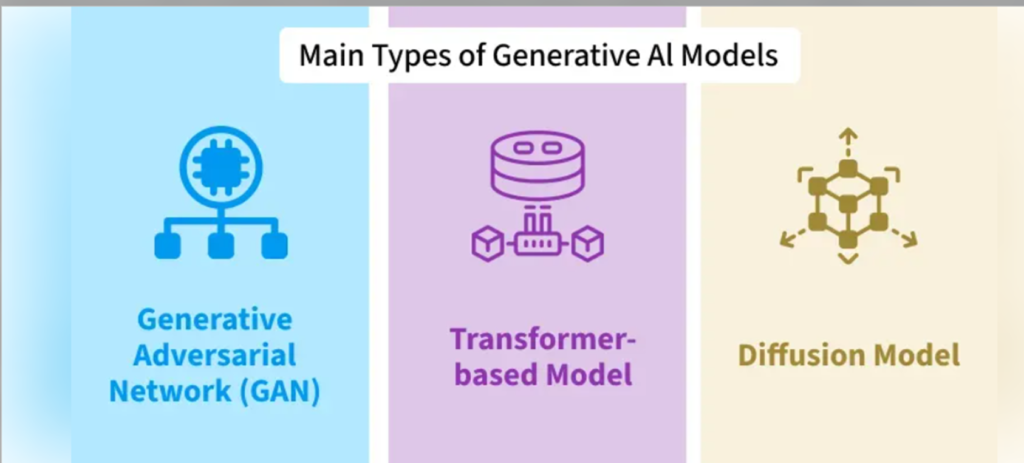
Transformers
Generate content token by token, predicting the next word based on previous words.
Use self-attention mechanism to understand context.
Highly effective for text and code generation.
Example: GPT
Limitation: Can be slower for long outputs since generation is step-by-step.
Diffusion Models
Start with random noise and gradually remove noise to create realistic output.
Produce high-quality images and audio.
Used in image synthesis and editing tasks.
Examples: Stable Diffusion, DALL·E 3
Strong for inpainting, style transfer, and text-to-image generation.
Generative Adversarial Networks (GANs)
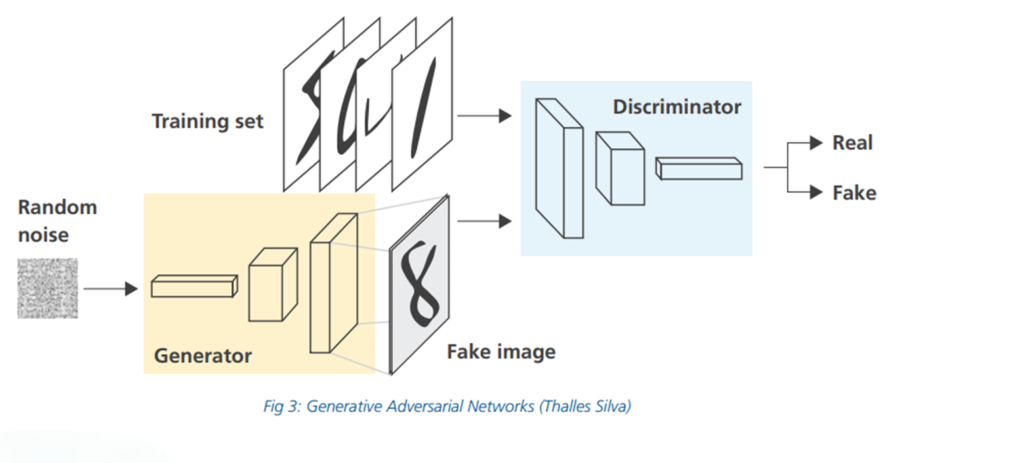
GANs use two competing neural networks, a generator and a discriminator. The generator, also known as the generative network, is a neural network responsible for producing new data or content comparable to the original data.
A discriminator, also known as a discriminative network, is a neural network that differentiates between source and produced data.
The competition between these two networks is to develop their algorithms until they can create data indistinguishable from the original material.
Application of Generative AI
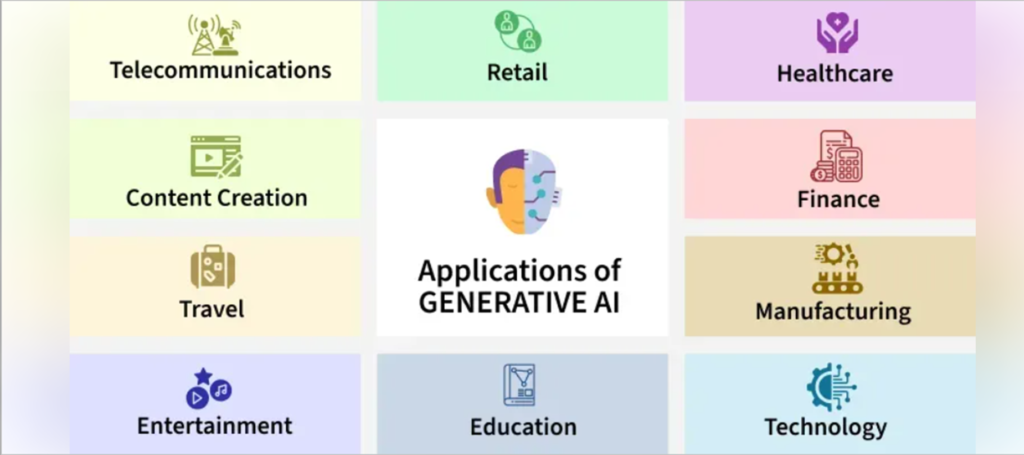
- Technology
- Finance
- Manufacturing
- Healthcare
- Retail
- Telecommunications
- Content Creation
- Travel
- Entertainment
- Education
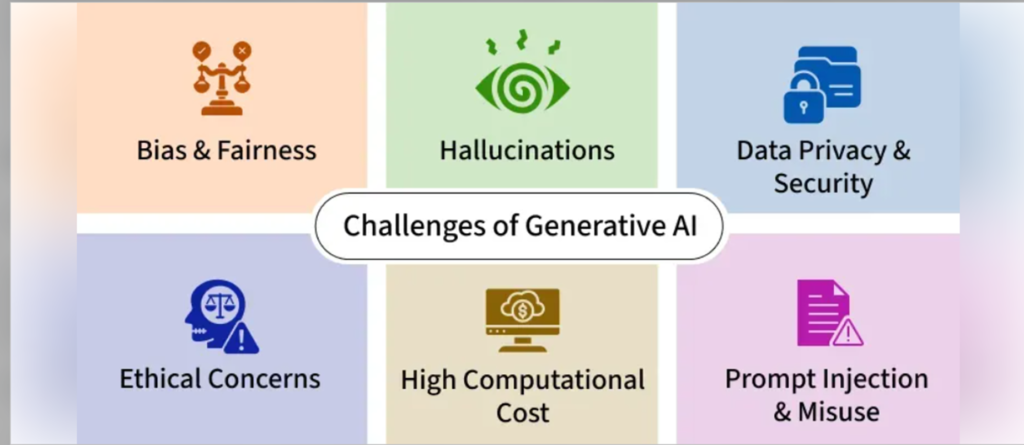
Challenges of Generative AI
- Data Privacy and Security
- Prompt Injection and Misuse
- High Computational Cost
- Ethical Concerns
- Hallucinations
- Bias and Fairness