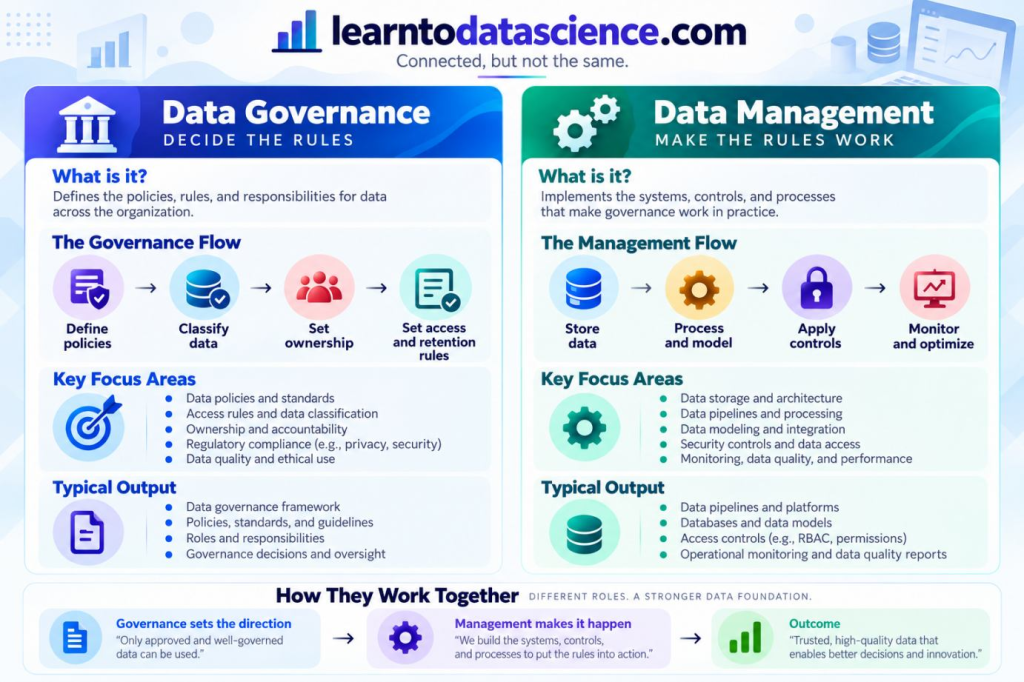
Data governance and data management are closely connected, but they are not the same thing.
As organizations collect increasing amounts of data, they need more than systems for storing and processing information. They also need clear rules for how data is accessed, protected, maintained, and used.
This is where data governance and data management come into play.
In simple terms: Data governance defines the rules, while data management puts those rules into practice.
Data governance is the framework an organization uses to establish policies, standards, responsibilities, ownership, and decision-making processes for data.
It answers questions such as:
Who owns this data?
Who can access it?
How should sensitive data be classified?
How long should data be retained?
What standards should data meet?
Who is responsible for data quality and compliance?
Key Areas of Data Governance
Data ownership Defines who is accountable for specific datasets or data domains.
Data access Establishes who should be allowed to access particular types of data.
Data classification Defines categories such as public, internal, confidential, or restricted data.
Data retention Establishes requirements for retaining, archiving, or deleting data.
Accountability Defines roles and responsibilities for making and enforcing data-related decisions.
What Is Data Management?
Data management is the practical process of collecting, storing, processing, organizing, protecting, integrating, and maintaining data.
While governance establishes what should happen, data management focuses on how those requirements are implemented.
For example, if governance requires sensitive customer information to be accessible only to authorized employees, data management can implement authentication, RBAC, permissions, masking, encryption, and audit logging.
Data Governance vs Data Management
Data Governance
Data Management
Defines policies
Implements policies
Establishes standards
Applies standards
Defines ownership
Operates data systems
Defines access rules
Implements access controls
Defines retention requirements
Implements retention processes
Establishes accountability
Executes operational processes
Focuses on rules and decisions
Focuses on implementation
Answers “What and why?”
Answers “How?”
How Data Governance and Data Management Work Together
Data governance and data management should not be viewed as competing functions. They work together to create a reliable and controlled data environment.
1. Governance Defines the Rules
For example:
Only authorized employees should have access to sensitive customer data.
2. Management Implements the Rules
Technical teams can implement:
Role-Based Access Control (RBAC)
Authentication
Database permissions
Data masking
Encryption
Audit logging
3. Monitoring Ensures the Rules Continue to Work
Organizations can monitor access, data quality, pipeline performance, and security events.
Imagine a company stores customer information in a cloud data warehouse.
Governance decides:
Which customer information is sensitive
Who owns the data
Which employees can access it
How long it should be retained
What security requirements apply
Data management implements:
Database permissions
RBAC
Data pipelines
Data masking
Encryption
Data-quality checks
Monitoring and logging
The result is a data environment where organizational policies can be applied consistently through technology and operational processes.
Why Both Are Important for Data Science
Data governance and data management are especially important for data science, analytics, and AI.
A data scientist may have a technically excellent model, but the model still depends on the quality, availability, security, and appropriate use of its underlying data.
Before using a dataset, teams may need to understand:
Where the data came from
Who owns it
What each field means
Whether the data is accurate
Whether sensitive information is included
Whether the data can be used for the intended purpose
How the dataset should be accessed and protected
Data management then provides the technical infrastructure needed to deliver reliable data to analysts and data scientists.
Data management requires technical capabilities, but it also involves business teams.
Data is created and used throughout an organization, so effective data management often requires collaboration between business users, data professionals, security teams, compliance teams, and IT.
Data Governance vs Data Management: The Easy Way to Remember
Think of data governance as the rulebook and data management as the execution.
Data Governance
What should we do with the data, who is responsible, and why?
Data Management
How do we store, process, protect, integrate, and use the data?
Together, they help organizations turn raw information into data that can be responsibly used for analytics, reporting, applications, and AI.
Conclusion
The simplest distinction is:
Data governance defines the rules, responsibilities, and decision rights. Data management implements and operates the systems and processes that make those rules work.
Neither should be considered in isolation. Governance provides direction and accountability, while data management provides the operational and technical capabilities required to put that direction into practice.
For data professionals, understanding the relationship between these two concepts is an important foundation for working with modern data platforms, analytics, and AI.
Introduction In today’s digital economy, organizations generate enormous volumes of data from multiple sources such as applications, IoT devices, social media, sensors, business systems, audio, video, and transactional platforms. Traditional…