Predictive AI focuses on forecasting or predicting future outcomes based on historical data. It blends statistical analysis and machine learning to find patterns and predict events or trends.
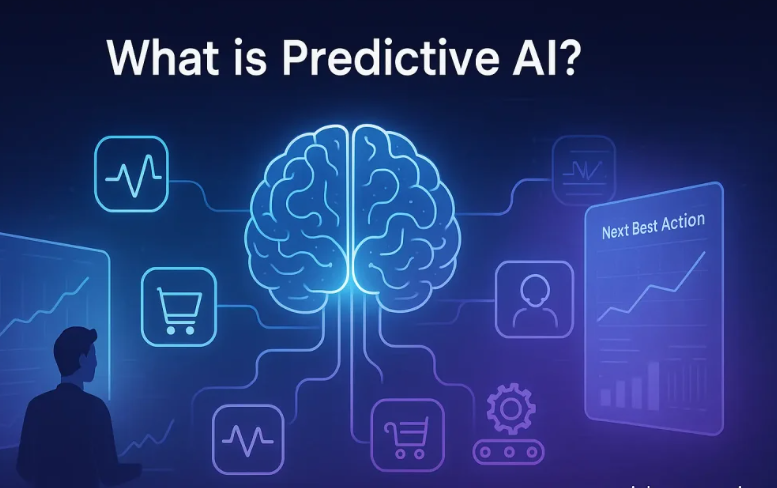
It is widely used for forecasting, trend analysis, business decisions, and optimization, enabling data-driven decisions.
Predictive AI works by learning patterns from historical data and using those patterns to forecast future outcomes. Here’s a clear breakdown of what’s happening behind the scenes:
1. Data collection and preparation
Everything starts with data from sources like transactions, sensors, user behavior, or financial records.
Before anything else, this data must be:
- Cleaned (removing errors, missing values, duplicates)
- Standardized (so formats are consistent)
- Filtered (keeping only relevant variables)
The quality of predictions depends heavily on this step—bad data leads to bad predictions.
2. Training and testing the model
The dataset is split into two parts:
- Training set: used to teach the model patterns and relationships
- Testing set: used to check how well the model performs on unseen data
The model adjusts its internal parameters repeatedly to reduce prediction errors.
3. Learning patterns with algorithms
Different algorithms are used depending on the problem:
- Linear regression: predicts continuous values (like price or sales)
- Logistic regression: predicts categories (like yes/no outcomes)
- Decision trees: make predictions by splitting data into branches
- Support vector machines: separate data into clear groups
- Neural networks: learn complex patterns, especially in large datasets
- K-means clustering: groups similar data together (pattern discovery)
Each algorithm has strengths depending on the type of prediction needed.
4. Optimization (how learning improves)
During training, the model:
- Makes predictions
- Compares them to actual outcomes
- Calculates errors
- Adjusts itself to reduce those errors
This loop repeats many times until performance stabilizes.
5. Embeddings (finding similarity efficiently)
Modern systems often convert data into numerical “vectors” called embeddings.
These help the AI:
- Measure similarity between items
- Quickly retrieve related information
- Improve prediction speed and relevance
6. Using big data for better accuracy
More diverse and larger datasets generally improve performance because the model sees more real-world variation. However, poor-quality or biased data can reduce reliability.
7. Explainability and ethics
Good predictive AI should be:
- Transparent: so humans can understand why a prediction was made
- Fair: avoiding biased or discriminatory outcomes
- Responsible: not over-relied upon for decisions involving people
Generative AI Vs. Predictive AI

| Feature | Generative AI | Predictive AI |
| Primary Function | Create new content | Forecast outcomes |
| Data Type | Large, unstructured | Historical, structured |
| Output | Text, images, audio, code | Predictions, trends, scores |
| Core Algorithms | Transformers, GANs, Diffusion Models | Regression, trees, clustering |
| Explainability | Often complex | Relatively interpretable |
| Typical Use | Content creation and interaction | Forecasting & decision support |