Introduction
In today’s digital economy, organizations generate enormous volumes of data from multiple sources such as applications, IoT devices, social media, sensors, business systems, audio, video, and transactional platforms. Traditional data architectures often struggle to handle the growing complexity, scale, and speed of modern data environments. To address these challenges, organizations are increasingly adopting the Data Lakehouse architecture.
A Data Lakehouse combines the flexibility and scalability of a Data Lake with the performance, governance, and reliability of a Data Warehouse. This modern architecture supports unified analytics, real-time processing, machine learning, and business intelligence within a single platform.
This article explores the fundamentals of Data Lakehouse architecture, its advantages, core architectural principles, and how organizations can evaluate and align their data architecture with business strategy and long-term goals.
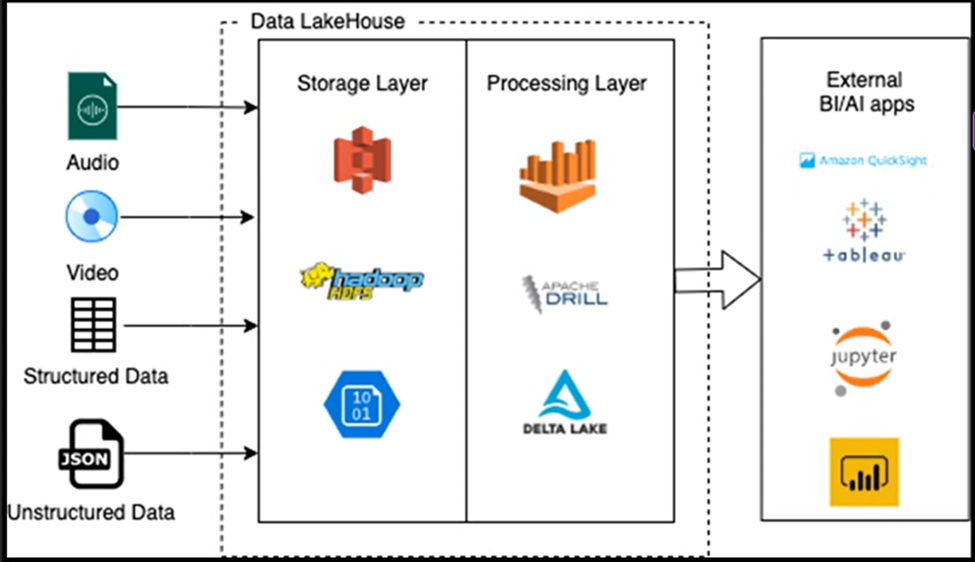
Understanding Data Lakehouse Architecture
A Data Lakehouse is a hybrid data management architecture that integrates the best capabilities of data lakes and data warehouses into a unified environment.
Traditional data lakes provide scalable and low-cost storage for raw data but often lack governance and optimized analytical capabilities. On the other hand, data warehouses deliver structured analytics and strong governance but can become expensive and inflexible when handling large volumes of diverse data types.
The Data Lakehouse bridges this gap by enabling organizations to store all data types while supporting high-performance analytics, governance, and advanced data processing.
Core Components of a Data Lakehouse
Data Lake
A data lake serves as the foundational storage layer of the architecture. It stores data in its native format, including:
- Structured data
- Semi-structured data
- Unstructured data
Examples include:
- Audio files
- Video content
- JSON documents
- Sensor data
- Log files
- Relational datasets
Data lakes are highly scalable and cost-effective because they typically use distributed object storage systems such as Amazon S3 or Hadoop Distributed File System (HDFS).
Key Features
- Schema-on-read flexibility
- Massive scalability
- Low storage cost
- Support for multiple data formats
Data Warehouse Capabilities
A Data Lakehouse incorporates data warehouse functionalities to improve data reliability and analytical performance.
These capabilities include:
- ACID transactions
- Schema enforcement
- Data consistency
- Query optimization
- Data governance
- Security controls
This allows organizations to perform enterprise-grade analytics directly on data stored in the lakehouse environment.
Unified Analytics
One of the major strengths of a Data Lakehouse is the ability to support multiple analytical workloads from a single platform.
Organizations can perform:
- SQL analytics
- Business intelligence reporting
- Artificial intelligence (AI)
- Machine learning (ML)
- Real-time analytics
- Predictive modeling
This unified approach eliminates data silos and reduces the need for multiple disconnected systems.
Delta Lake
Delta Lake is an open-source storage layer that enhances reliability and governance in data lake environments.
Delta Lake provides:
- ACID transaction support
- Data versioning
- Time travel functionality
- Schema evolution
- Streaming and batch processing support
These capabilities improve data quality, consistency, and operational reliability.
Advantages of Data Lake Architecture
Modern organizations adopt Data Lakehouse architectures because they offer several strategic and operational benefits.
Cost Efficiency
Data lakes use low-cost distributed storage systems, making them significantly more economical than traditional warehouse-only architectures.
Benefits include:
- Reduced infrastructure costs
- Efficient storage scaling
- Lower operational expenses
- Optimized compute resource usage
Organizations can store petabytes of data at a fraction of traditional warehouse costs.
Stability and Reliability
Distributed storage and processing frameworks provide high availability and fault tolerance.
Stability advantages:
- Data replication
- Fault tolerance
- Disaster recovery support
- High availability architectures
These features ensure continuous operation even during hardware or system failures.
Flexibility
A Data Lakehouse can ingest and process almost any type of data without requiring predefined schemas.
Flexibility includes:
- Support for diverse data sources
- Integration with multiple analytics tools
- Adaptability to changing business needs
- Support for evolving data models
This flexibility enables organizations to innovate rapidly.
Real-Time Analytics
Modern businesses increasingly require real-time insights to support operational and strategic decisions.
A Data Lakehouse supports:
- Streaming data ingestion
- Event-driven processing
- Near real-time dashboards
- Real-time AI and analytics
This capability is critical for industries such as finance, healthcare, telecommunications, and e-commerce.
Challenges and Considerations
Although Data Lakehouse architectures offer substantial benefits, organizations must also address several challenges.
Data Governance
Strong governance is essential to maintain data quality, security, and compliance.
Governance considerations:
- Metadata management
- Data lineage tracking
- Access control
- Compliance management
- Data cataloging
Without proper governance, data lakes can become unmanageable “data swamps.”
Required Skillsets
Implementing and maintaining modern data architectures requires specialized expertise.
Organizations need professionals skilled in:
- Cloud computing
- Big data technologies
- Distributed systems
- Data engineering
- DevOps and automation
- AI and analytics platforms
Training and talent acquisition are critical success factors.
Managing Large Data Volumes
As data volumes grow exponentially, organizations must optimize storage and query performance.
Challenges include:
- Storage lifecycle management
- Query optimization
- Compute resource allocation
- Data archival strategies
Proper architecture planning is essential for sustainable scalability.
Principles and Core Components of Modern Architectural Approaches
Modern data architectures follow several foundational principles that improve scalability, maintainability, and operational efficiency.
Separation of Concerns (SoC)
Different architectural layers handle specific responsibilities independently.
Examples:
- Storage layer
- Processing layer
- Analytics layer
- Governance layer
This improves maintainability and simplifies system upgrades.
Modularity and Reusability
Architectural components should be reusable and independently deployable.
Benefits:
- Faster development
- Easier maintenance
- Reduced duplication
- Improved scalability
Microservices and modular pipelines are common examples.
Scalability and Performance
Modern systems must scale horizontally to accommodate increasing workloads.
Key considerations:
- Distributed computing
- Parallel processing
- Load balancing
- Elastic cloud resources
Performance optimization is critical for large-scale analytics.
Security
Security must be integrated into every layer of the architecture.
Security practices include:
- Encryption
- Authentication
- Authorization
- Role-based access control
- Auditing and monitoring
Data protection is especially important for regulated industries.
Flexibility and Adaptability
Organizations must respond quickly to changing business requirements and emerging technologies.
Modern architectures should support:
- Hybrid cloud deployments
- Multi-cloud environments
- New analytics frameworks
- Evolving data formats
Maintainability and Documentation
Comprehensive documentation improves operational efficiency and reduces technical debt.
Good practices:
- Standardized documentation
- Clear architecture diagrams
- Automated monitoring
- Version control
Maintainable systems reduce long-term operational costs.
Testing and Quality Assurance
Data quality and system reliability must be continuously validated.
Key practices:
- Automated testing
- Data validation pipelines
- Continuous integration and deployment (CI/CD)
- Observability and monitoring
Testing ensures trust in analytical outputs.
Evaluating Data Architecture Needs
Organizations should align their data architecture decisions with long-term business objectives and digital transformation strategies.
1. Define Your Data Strategy and Roadmap
A successful architecture begins with a clearly defined strategy.
Data Strategy
Organizations should identify:
- Business objectives
- Analytics goals
- AI and automation priorities
- Governance requirements
Roadmap
A roadmap defines:
- Implementation phases
- Technology adoption plans
- Key milestones
- Performance indicators
2. Understand Your Data Requirements
A detailed understanding of data characteristics is essential.
Data Sources
Organizations may collect data from:
- Enterprise applications
- APIs
- IoT devices
- External systems
- Streaming platforms
Data Volume
Estimate both current and future storage requirements.
Data Variety
Architectures should support:
- Structured data
- Semi-structured data
- Unstructured data
Data Velocity
Determine whether workloads require:
- Batch processing
- Real-time streaming
- Near real-time analytics
Data Quality
Ensure:
- Accuracy
- Consistency
- Completeness
- Reliability
3. Map the Data Lifecycle
Understanding the full data lifecycle helps optimize architecture design.
Data Ingestion
Methods include:
- Batch ingestion
- Streaming ingestion
- API-based ingestion
Data Storage
Options include:
- Data lakes
- Warehouses
- Lakehouses
Data Processing
Processing frameworks may include:
- ETL/ELT pipelines
- Distributed analytics engines
- Stream processing systems
Data Analysis
Support for:
- BI dashboards
- AI/ML workloads
- Self-service analytics
Governance and Security
Implement:
- Compliance controls
- Data lineage
- Security policies
4. Assess Scalability and Flexibility
Architectures should support future growth without major redesign.
Key capabilities:
- Cloud-native scalability
- Elastic compute resources
- Hybrid and multi-cloud support
5. Consider the Technology Stack
Choosing the right technologies is critical.
Example technologies:
| Layer | Technologies |
|---|---|
| Storage | Amazon S3, HDFS |
| Processing | Apache Spark, Apache Drill |
| Query Engines | Hive, Presto |
| Visualization | Tableau, Power BI |
| AI/ML | Jupyter, Databricks |
6. Ensure Governance and Compliance
Regulatory compliance is a major architectural consideration.
Important areas:
- GDPR compliance
- HIPAA compliance
- Audit trails
- Data retention policies
- Access management
Strong governance reduces operational and legal risks.
7. Continuously Monitor and Optimize
Modern architectures require ongoing optimization.
Continuous improvement areas:
- Performance monitoring
- Cost optimization
- Data quality monitoring
- Infrastructure modernization
Organizations should regularly reassess architecture effectiveness.
Conclusion
The Data Lakehouse represents a transformative approach to modern data architecture by combining the scalability of data lakes with the reliability and analytical capabilities of data warehouses. It enables organizations to manage massive volumes of diverse data while supporting real-time analytics, machine learning, business intelligence, and advanced governance.
By following modern architectural principles such as modularity, scalability, security, and separation of concerns, organizations can build flexible and future-ready data platforms.
However, successful implementation requires careful planning, skilled professionals, strong governance, and continuous optimization. Organizations that align their data architecture with business strategy and long-term roadmaps will be better positioned to unlock the full value of their data and drive innovation in the digital era.
What is a Data Lakehouse?
Data and AI Career Paths Explained: Data Analyst to GenAI Engineer